In this post, we will explore the concept of “Employee Invention” (Job Invention). This topic is crucial for both companies and researchers because it often leads to complex legal disputes regarding ownership and compensation. Specifically, we will look at a recent court ruling that defines exactly “when” an invention is considered complete—a key factor when an employee moves to a new company.
What is an “Employee Invention”?
Under Korean Patent Law, an “Employee Invention” is defined as an invention that meets all four of the following criteria:
- It is made by an employee (or officer, public official).
- It is related to their duties.
- By its nature, it falls within the employer’s scope of business.
- The act leading to the invention belongs to the employee’s present or past duties.
Rights and Obligations
- Initial Ownership: The employee initially acquires the “right to obtain a patent.”
- Duty to Notify: The employee must immediately notify the employer upon completing the invention.
- Employer’s Rights: The employer generally has a non-exclusive license by law. If there is a contract or employment regulation in place, the employer can preemptively succeed to the right to the invention.
- Compensation: If the employer succeeds to the right, the employee is legally entitled to “fair compensation.”
The Critical Issue: “Time of Completion”
The two biggest legal battlegrounds in this area are:
- Is it a valid employee invention? (Ownership dispute)
- How much is the fair compensation? (Money dispute)
The first question often arises when a researcher changes jobs. Was the invention made at the previous company, the new company, or during the break?
The “duty” refers to the employee’s duty at the time the invention was completed.
- Completed during employment: = Employee Invention (Employer likely owns it).
- Completed after resignation or before joining: = Free Invention (Belongs solely to the individual).
If an employer files a patent for an invention that is technically a “free invention” (e.g., completed before the employee joined), the patent can be invalidated as a misappropriated application.
Therefore, determining the exact “Time of Invention Completion” is the deciding factor. Since inventing is a process—from initial idea to research, experiments, and data collection—courts must determine the precise moment it became a “complete invention.”
Case Study: Artificial Fish Hibernation Method
(Patent Court Judgment 2022Heo5584, Decided May 19, 2023)
Let’s analyze a recent Patent Court case concerning a “method and container for inducing artificial hibernation in fish.”
The Facts
- Company A: A startup established in Nov 2016.
- Dr. B (Employee): A marine biology expert who joined Company A as a researcher/director in Nov 2016 (immediately after its founding).
- Timeline:
- Jan 2017: Company A filed the 1st Patent Application based on Dr. B’s initial ideas.
- Dec 2017: Company A filed the 2nd Patent Application (The Patent at Issue), claiming domestic priority from the 1st application. This version included new experimental data and adjustments.
- The Dispute: Dr. B later claimed, “I completed this invention personally between 2009 and 2016, before I joined Company A. Therefore, it is my free invention, and Company A has no right to it.” He sought to invalidate the patent.
The Court’s Analysis: Defining “Completion”
To decide if the invention was “completed” before or after hiring, the court compared the technical features of the final patent with the initial concept.
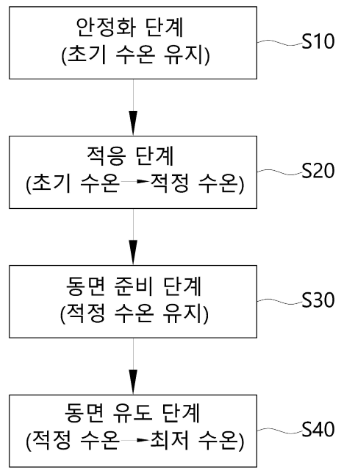
Technical Features of the Final Patent (2nd App):
- Hibernation Preparation Time: Set to 23-25 hours (to maintain hibernation for over 36 hours).
- Oxygen Supply: Used solid potassium superoxide mixed with gypsum at a 20:80 weight ratio (to prevent ignition).
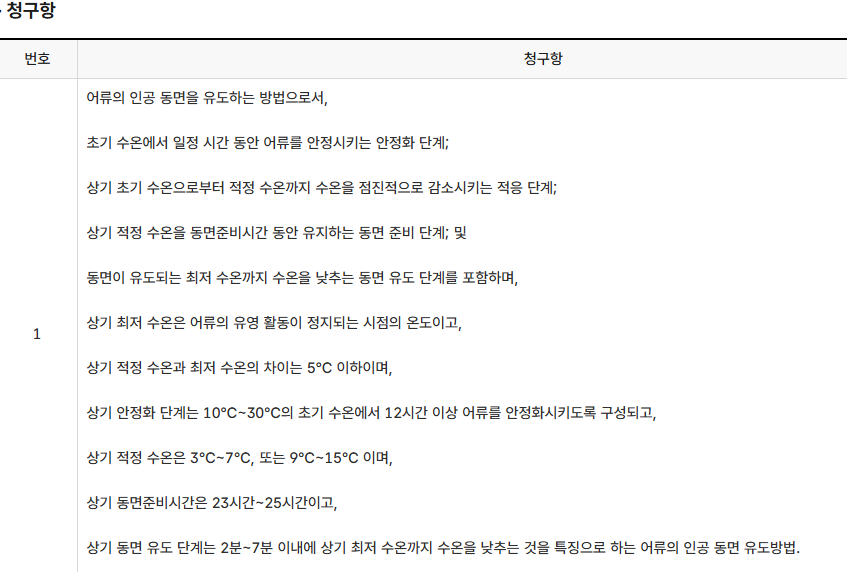
Comparison with the 1st Application: The court found that the 1st application (filed shortly after hiring) was merely a concept without sufficient data.
- Regarding Feature 1: The 1st application stated a preparation time of “11 to 13 hours.” The final patent changed this to “23-25 hours” and added critical comparative data showing that 24-hour preparation resulted in a 93% survival rate (vs. 20% for 12 hours). This data was generated during his employment at Company A.

- Regarding Feature 2: The 1st application mentioned potassium superoxide generally but had no mention of the specific “20:80 mixture with gypsum” which was essential for safety. This specific ratio appeared only in the 2nd application.
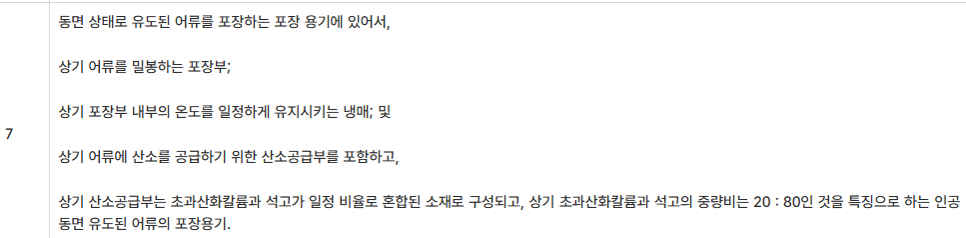

The Verdict: It IS an Employee Invention
The court ruled that the invention was NOT completed before Dr. B joined the company (Patent Court of Korea, May 19, 2023, Case No. 2022Heo5584).The key technical features (specific time and chemical ratio) were established between Jan 2017 and Dec 2017, while Dr. B was employed by Company A and using its resources. Therefore, it is a valid Employee Invention, and Company A is the rightful owner.
Conclusion: The “Technical Feature” Test
The key takeaway for businesses and researchers is this:
An invention is considered “completed” not when the idea is conceived, but when its specific technical features are established to the point where the desired result is reproducible.
Courts look for the moment when critical data, specific parameters, and concrete means of implementation are finalized. If that happens while you are on the payroll, it is likely an employee invention.
In our next post, we will discuss the second major issue: How to calculate “fair compensation” for these inventions.
Sarang IP We provide expert legal counsel on Korean IP Law, including employee invention disputes, patent invalidation, and compensation litigation.
(Disclaimer: This post is for informational purposes only and does not constitute specific legal advice. Please consult with a professional attorney regarding your specific case.)