(Recent Success Case Analysis: Patent Court Judgment on “Target Invention Specification”)
Today, I want to share a recent victory in a Scope Confirmation Trial (Patent Court). We successfully argued that the plaintiff’s case should be dismissed because they failed to properly define the accused product.
In Korea, a “Scope Confirmation Trial” is a unique administrative trial often used as a prelude to a full-blown civil infringement lawsuit. It allows a patent holder to ask the Intellectual Property Trial and Appeal Board (IPTAB): “Does this specific product (Target Invention) fall within the scope of my patent?”
While it is a common procedure, it contains a fatal trap. Many claimants focus solely on arguing “Infringement vs. Non-infringement.” However, the battle is often lost before it even begins, at the stage of defining the “Target Invention” (the accused product).
If you fail to define the target invention precisely, the court will dismiss the case without even examining whether there was infringement. Here is why this happens and how to avoid it.
The Legal Standard: Why “Specifics” Matter
In a Scope Confirmation Trial, the claimant must first clearly specify the “Target Invention” (often called the (Ga)-ho invention in Korean practice).
The court requires this specification for two reasons:
- Distinguishability (Res Judicata): The target must be distinct enough from other products so that the ruling’s effect is clear and final.
- Comparability: The target must be described specifically enough to allow for an element-by-element comparison with the registered patent’s claims.
The Trap of “Dismissal” (Kak-ha)
Korean courts are strict. As established in Supreme Court Precedent (Supreme Court of Korea, Sept. 8, 2011, Case No. 2010Hu3356), if the target invention is vague or its elements are unclear:
“…even if a judgment could be made based on the remaining clear elements, the request must be dismissed (Kak-ha).”
“Dismissal” is different from “Rejection.” Rejection means you fought and lost on the merits. Dismissal means your application was legally defective, and the court refused to even hear your arguments.
Case Study: “Pigment” vs. “Color-Imparting Component”
In a recent case I handled, the importance of this definition was the deciding factor.
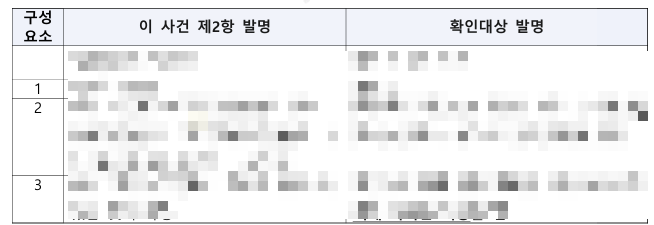
- The Patent: A “UV-blocking tape” where a key element involved a fiber layer containing “Pigment.”
- The Plaintiff’s Definition: The Plaintiff defined the accused product (Target Invention) as having a fiber layer with a “Color-imparting component” that gives it a skin-like color.
The Problem
To a layperson, “Pigment” and “Color-imparting component” might sound similar. However, legally and chemically, they are worlds apart.
- Pigment: Insoluble particles.
- Dye: Soluble substances.
The court noted:
- “Color-imparting component” could mean Pigment OR Dye.
- If it is Pigment → It might infringe the patent.
- If it is Dye → It likely does not infringe (under the doctrine of equivalents).
The Verdict
Because the conclusion (Infringement vs. Non-infringement) would change entirely depending on whether the substance was a pigment or a dye, the term “Color-imparting component” was too vague.
The Patent Court ruled:
“Since the Target Invention was not legally specified, the trial request itself was unlawful.”
Consequently, the court overturned the lower decision and dismissed the case. The plaintiff lost the opportunity to even argue infringement because they failed to define the target precisely.
Why Do Plaintiffs Make This Mistake?
From my 20 years of experience, this error usually stems from “Strategic Ambiguity.”
The plaintiff likely didn’t know for certain whether the competitor used a pigment or a dye. So, they intentionally used a broad term (“Color-imparting component”) hoping to catch either scenario.
This strategy backfired. In a Scope Confirmation Trial, the burden of specification lies entirely with the claimant. The court does not interpret ambiguity in the claimant’s favor. Instead, it views ambiguity as an impossibility to judge, closing the door on the case.
Strategic Advice: Define the Target Clearly
The goal of defining the Target Invention is not to make it “easy to win,” but to make the “subject of the dispute clear.”
- Be Precise: The definition must match the actual product you want to stop.
- Avoid Ambiguity: Do not try to hide unfavorable elements or use broad terms to cover multiple possibilities.
- Do Your Homework: Analyze the competitor’s product thoroughly before filing the trial. If you are unsure about the composition, you risk a dismissal.
If you are preparing for a patent dispute in Korea, before worrying about the legal arguments of infringement, ask yourself: “Have we defined the target exactly?”
If the first button is buttoned wrong, the shirt will never fit.
Sarang IP We provide expert legal counsel on Korean Patent Litigation, Scope Confirmation Trials, and infringement defense.
(Disclaimer: This post is for informational purposes only and does not constitute specific legal advice. Please consult with a professional attorney regarding your specific case.)