When a foreign company begins selling in Korea, packaging and product pages are usually localised for language, units and safety labelling. The intellectual property notices are almost never touched. The patent number that has sat on the box since the product launched at home stays exactly where it is.
In Korea, that carried-over line is not a labelling detail. False marking of an IP right is a criminal offence under the Patent Act, and the Ministry of Intellectual Property (MOIP), the Korean IP office, elevated to ministry status in October 2025 and long known abroad as KIPO, has moved from one-off sweeps to continuous, AI-assisted monitoring of online listings. Companies that were told to correct a listing in the past are now being checked again, across every platform they sell on.
What the law actually says
Article 224 of the Patent Act prohibits marking a product, or its packaging, advertising or any related material, as patented, or as the subject of a pending application, when it is not. Article 228 makes a violation punishable by imprisonment of up to three years or a fine of up to KRW 30 million. Materially identical provisions appear in the Utility Model Act, the Design Protection Act and the Trademark Act, so the exposure is the same whichever right is being claimed.
In practice, most cases are resolved through an administrative correction order rather than prosecution, and criminal liability requires intent. But that distinction offers less comfort than it first appears. Once a company has received a correction order and the same marking reappears, the argument that the marking was an oversight becomes considerably harder to make.
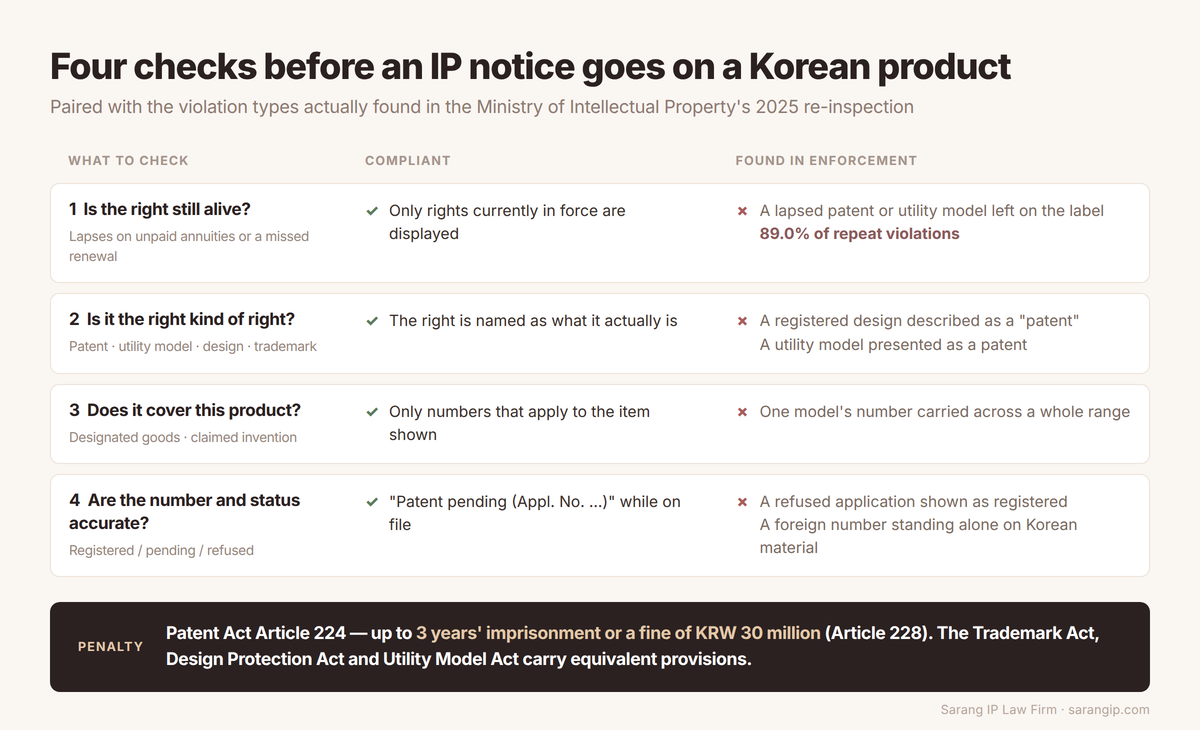
Four questions worth asking about every IP notice
Is the right still alive? A patent lapses when an annuity goes unpaid; a trademark lapses when a renewal is missed. Where the portfolio is managed by a foreign parent and the marketing material is produced by the Korean subsidiary or a local distributor, the lapse and the label rarely find each other.
Is it the right kind of right? “Patent” is used loosely in ordinary English. In Korea it is not. Describing a registered design as a patent, or a utility model registration as a patent, is a misstatement of the right, even when a genuine registration exists behind it.
Does it cover this product? A number that belongs to one model in a range routinely migrates onto the whole range. The right has to correspond to the goods it is displayed on: the designated goods for a trademark, the claimed invention for a patent.
Is the number, and the status, accurate? “Patent pending” is legitimate only while an application is actually on file, and Korean practice expects the application number to be shown. An application that has been refused, withdrawn or abandoned cannot continue to support the phrase.
The specific trap for foreign sellers
A Korean patent right is territorial. A US or EP patent number gives a product no protection in Korea, and displaying it on Korean-market material without identifying the jurisdiction invites the reading that the product is patented here. The safe practice is simple: state the country with the number (“US Patent No. …”), and never let a foreign number stand alone on Korean packaging or a Korean product page.
The same applies to “Patent Pending”. If the application exists only in the home jurisdiction, the phrase should not appear unqualified on Korean-market material.
Why this became urgent
Between January and September 2025 MOIP re-examined 2,507 sellers that had previously been subject to correction orders, and identified 1,263 further violations, the largest number ever detected in a single planned investigation.
Two findings matter for compliance planning. First, 86 sellers (3.4%) had simply relisted the same products on a different platform, producing 236 violations. Second, and more revealing, the dominant violation type was not exaggeration but neglect: displaying rights that had already lapsed accounted for 89.0% of repeat violations and 68.5% of the newly relisted cases. Patents were the right most often misstated.
The office has said it will now work with online platforms to remove source content, build a database of past violations, and use AI-based monitoring to detect previously flagged markings when they resurface elsewhere. A correction accepted on one marketplace no longer closes the matter.
A practical audit
- Inventory every IP notice across all Korean-facing channels: packaging, manuals, the company site, marketplace listings, distributor and reseller pages.
- Verify each right’s current status on KIPRIS, MOIP’s free search service.
- Match each number against the specific product it appears on.
- Assign one owner for IP marking, in writing. Where marketing sits in Korea and the portfolio sits abroad, this is the gap that produces violations.
- Extend the review to channels you do not control directly. Distributors and resellers copy your material, and their listings still point back to your brand.
Very few of these cases involve a company trying to mislead anyone. They involve a label that was accurate three years ago and nobody’s job to check. That is a manageable problem, but only if someone is looking.
References
Korean Patent Act, Articles 224 and 228: prohibition of false marking; penalties
Ministry of Intellectual Property (MOIP), results of the 2025 re-inspection of IP false marking · policy briefing
KIPRIS: Korea Intellectual Property Rights Information Service: kipris.or.kr
This content is for general informational purposes only and does not constitute legal advice. For specific matters, please contact Sarang IP Law Firm.