In April 2026 the US Supreme Court declined to hear Curtin v. United Trademark Holdings, ending a six-year effort by a law professor and doll collector to stop the registration of RAPUNZEL for dolls and toy figures. She argued the name was generic and failed to function as a mark. No tribunal ever ruled on that.
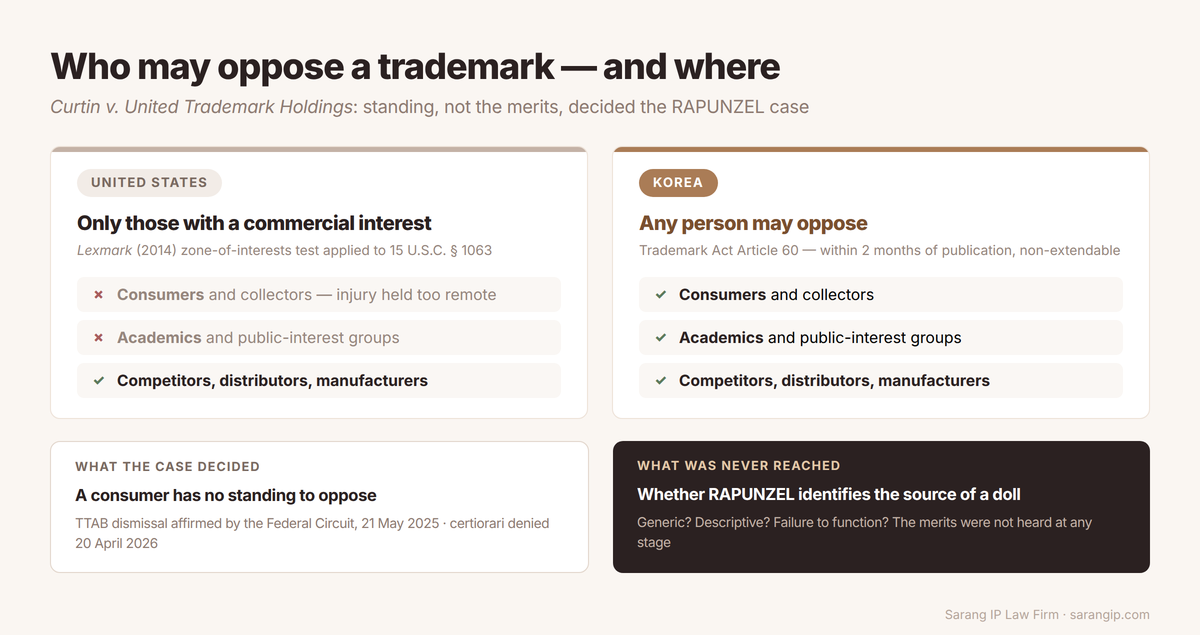
The case ended on standing. The TTAB dismissed it, the Federal Circuit affirmed on 21 May 2025, and the Supreme Court denied certiorari on 20 April 2026, all on the ground that a consumer is not within the zone of interests that 15 U.S.C. § 1063 protects, following Lexmark (2014). Her claimed injury, higher prices and fewer competing dolls, was held too remote.
For anyone managing a trademark portfolio that includes Korea, the interesting part is not the American outcome. It is that the same opposition would have been heard on its merits in Korea.
Korea asks who you are only after registration
Under Article 60 of the Korean Trademark Act, any person may oppose a published application. Not an interested party, not a competitor: any person. There is no standing inquiry, and the opponent is not asked to show commercial injury.
The trade-off is time. The window is two months from publication in the Trademark Gazette, and it cannot be extended. In practice it works in two stages: a notice of opposition with a summary of grounds within the first 30 days, and a further 30 days to supplement and evidence them. Miss the window and the open door closes.
Because after registration the position reverses. An invalidation trial under Article 117 is available to an interested party or an examiner, a standing requirement that looks much more like the American rule. Korea is permissive early and restrictive late; the United States is restrictive throughout.
What this gives a foreign brand owner
The obvious use is defensive. If a third party in Korea files something uncomfortably close to your brand, you can oppose it without first proving that you have a Korean registration, Korean sales, or a demonstrable commercial injury. That matters most in exactly the situation where a brand owner is weakest: you have not entered Korea yet, someone has noticed your name, and your evidence of local reputation is thin. In a standing-based system that is a hard place to start. In Korea it is not a threshold question at all.
Opposition is also cheaper and faster than cancelling a registration later, and it stops the right before it exists rather than unwinding it afterwards.
And what it exposes
The same rule runs the other way. Your own Korean applications can be opposed by anyone: a competitor’s counsel, an industry body, an individual with a grievance, a party with no commercial position at all. There is no standing filter to knock those out at the door.
This makes the publication window a live risk rather than an administrative formality. Two months is short, it is not extendable, and it runs from a gazette publication that nobody will send you. A brand owner filing in Korea should know its publication dates in advance and have someone watching, and should equally be watching competitors’ publications, because that is the only moment when the cheap remedy is available.
The part of the RAPUNZEL case worth remembering
Six years of proceedings, three levels of review, and the question actually raised, whether a fairy-tale name can indicate the commercial source of a doll, remains unanswered. It was never reached, because the person raising it was not permitted to raise it.
That is a coherent design choice. Standing rules keep proceedings in the hands of parties with something concrete at stake. But it means the merits of a registration depend on whether a qualifying party happens to notice and care. Korea made the opposite choice at the opposition stage, and the practical consequence for brand owners is straightforward: in Korea the pre-registration window is open to you, and open against you, on identical terms.
References
Curtin v. United Trademark Holdings, Inc., Fed. Cir. No. 2023-2050 (21 May 2025) · case note
Certiorari denied, 20 April 2026 · report
Lexmark Int’l, Inc. v. Static Control Components, Inc., 572 U.S. 118 (2014); 15 U.S.C. § 1063
Korean Trademark Act, Article 60 (opposition) and Article 117 (invalidation trial)
This content is for general informational purposes only and does not constitute legal advice. For specific matters, please contact Sarang IP Law Firm.