Patagonia sued the drag performer and environmental activist Pattie Gonia in January 2026, seeking one dollar in damages. The nominal figure was the point: the company said it was protecting a mark, not pursuing money. What actually triggered the suit was not the persona, which had existed since 2018: it was a 2025 trademark application and a shift into selling merchandise. Patagonia says this broke an earlier understanding between the parties; Pattie Gonia disputes that any broad agreement was ever reached. The case remains unresolved.
It is a useful case to think with, because it isolates the question that actually matters. The dispute did not turn on whether the parody was funny, or fair, or well-intentioned. It turned on the moment the name stopped being expression and started operating as a badge of origin for goods.
Korean law arrives at a similar place by a different road, and brand owners enforcing in Korea should know which road.
Korea has no free-standing parody defence
There is no equivalent in the Korean Trademark Act to the First Amendment analysis that shapes American parody cases. Korean courts have recognised that use which is purely expressive and not use “as a trademark” falls outside infringement, but the framing is narrower and the burden sits with the user. Once a name appears on goods that are sold, the expressive framing weakens quickly.
The more consequential difference is which statute does the work.
The fried chicken case, and why it matters to you
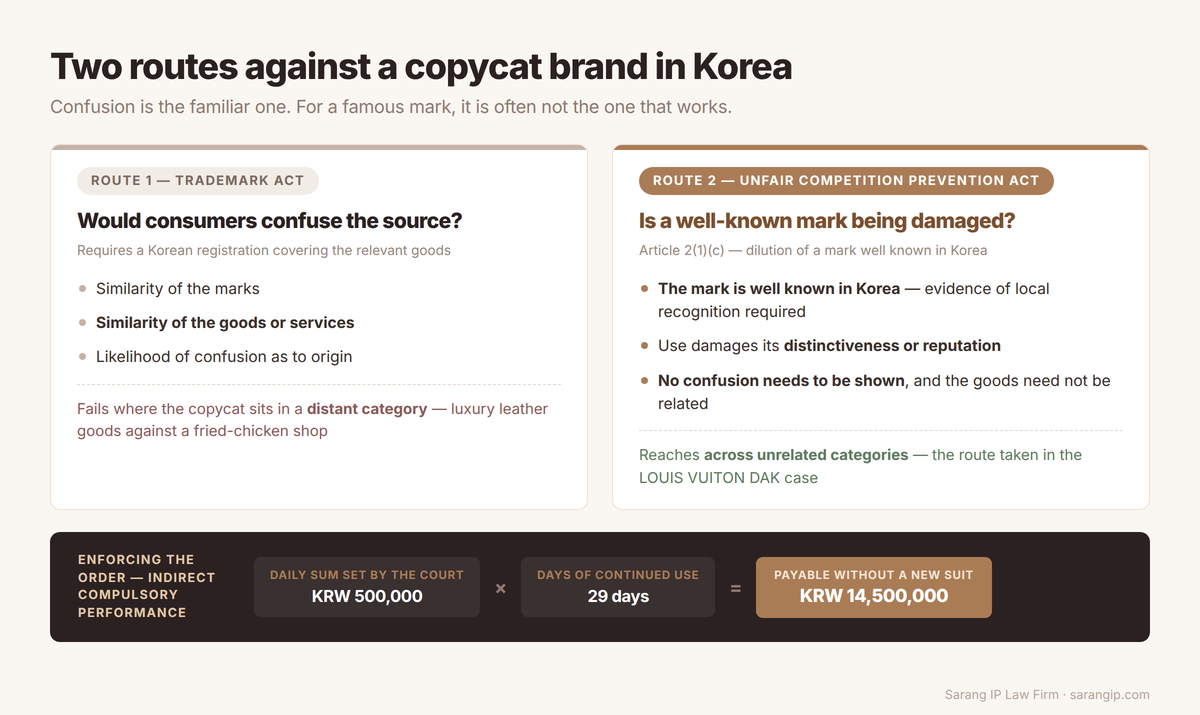
In 2016 a small Seoul chicken shop traded as LOUIS VUITON DAK, a pun stacking the luxury house onto tongdak, Korean fried chicken. Louis Vuitton Malletier acted, and the Seoul Central District Court ordered the owner to stop, setting a penalty of KRW 500,000 for each day of continued use.
Note what the claim was not. Nobody argued a consumer might buy fried chicken thinking it came from a French leather-goods house. The route was the Unfair Competition Prevention Act, Article 2(1)(c): use that damages the distinctiveness or reputation of a mark well known in Korea. Dilution, not confusion. It reaches across unrelated categories, and it does not require a Korean registration covering chicken restaurants.
For a foreign brand this is the practically important door. Copycats rarely appear in your own class; they appear in cafés, cosmetics, phone accessories and delivery apps, precisely where a confusion argument is weakest. The condition is evidentiary rather than formal: you must show the mark is well known in Korea specifically. Global fame is persuasive but not automatic: Korean advertising spend, local media coverage, market presence and survey evidence are what carry it.
Cosmetic renaming does not end it
The shop responded to the order by respacing and padding the name (cha LOUISVUI TONDAK) and continued trading. On 17 April 2016 the court rejected that, holding the name still read as the original when spoken.
The enforcement mechanism is the part foreign counsel most often underestimate. Korea provides indirect compulsory performance: the court fixes a sum payable for each day the order is disobeyed, and it accrues automatically. Twenty-nine days of continued use produced KRW 14.5 million, without a fresh infringement action, without proving damages again. An injunction in Korea is not a piece of paper you have to sue on twice; it is a meter that starts running.
What to take from both cases
Patagonia’s complaint and Louis Vuitton’s are, underneath, the same complaint: a name that was tolerated as expression began functioning commercially. The lesson for brand owners is about timing rather than tone. Tolerating an affectionate parody costs little; tolerating it after it starts selling goods and filing applications costs a great deal more, and the record of tolerance itself becomes the other side’s best argument.
Three things are worth doing now if you hold a well-known brand with any Korean exposure. Build and keep the evidence of Korean recognition before you need it: that file is what unlocks the dilution route. Watch the Korean register for applications, because an application is the clearest signal that expression is becoming commerce. And when you do obtain an order, ask for indirect compulsory performance at the same time, so that compliance has a price attached from day one.
References
Seoul Central District Court, decision of 17 April 2016 (LOUIS VUITON DAK) · report · Legal Times
Unfair Competition Prevention and Trade Secret Protection Act, Article 2(1)(c)
Patagonia v. Pattie Gonia, filed January 2026 · case background
This content is for general informational purposes only and does not constitute legal advice. For specific matters, please contact Sarang IP Law Firm.