(Key Issues in Non-Use Cancellation Trials: The “Identity” Test)
Brand renewal and logo modernization are essential for any business. However, as a patent attorney, I often witness a tragic scenario: a marketing success becoming a legal disaster. Simply changing your logo design slightly can sometimes lead to the cancellation of your registered trademark for “Non-Use.”
Under Article 119(1)(3) of the Korean Trademark Act, if a registered trademark is not used for 3 consecutive years, anyone can file for its cancellation. The critical defense here is proving that the trademark was used within the “Scope of Identity.”
Today, I will analyze the Supreme Court’s standards on this “Identity” test and provide practical advice for brand owners.
1. The Legal Battle: Burden of Proof
In a Non-Use Cancellation Trial, the rules are different from civil litigation. The burden of proof is reversed. The applicant does not have to prove you didn’t use the mark. Instead, YOU (the trademark owner) must prove that you DID use it.
To win, you must prove:
- Use within 3 years prior to the trial filing date.
- Use in Korea.
- Use on the designated goods.
- Use of the registered trademark or a trademark within the “Scope of Identity.”
Recently, I successfully defended a client in a grueling 2.5-year battle. The core issue? Whether their modified logo was “identical” enough to the registered one.
2. What is “Identical” Use? (The Supreme Court’s View)
The Korean Supreme Court is reasonable. It does not require the used mark to be a 100% pixel-perfect match with the registration. It accepts use that is “identical under ordinary notions of trade.”
The Key Standard:
“Use of a registered trademark includes not only the registered mark itself but also marks that are considered identical in social conception. This includes changing colors, fonts, or modifying auxiliary/non-distinctive parts, as long as the identity of the mark remains intact.” (Patent Court of Korea, Nov. 30, 2018, Case Nos. 2018Heo6122 and 2018Heo6139)
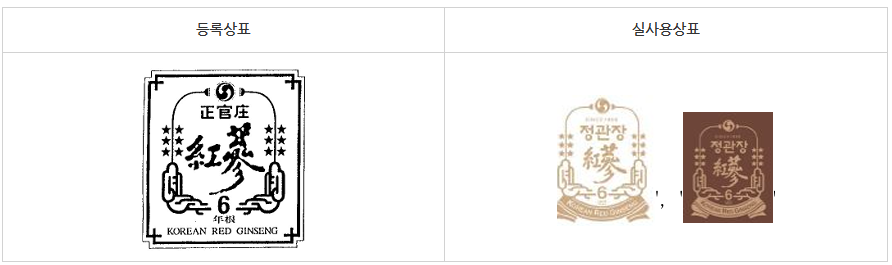
Case Study: “Cheong-Kwan-Jang” (Red Ginseng Brand) In this famous case, the registered mark was in Chinese characters (正官庄), but the actual use was in Korean (정관장) with a ribbon design added.
- Court’s Verdict: Identity Recognized.
- Reasoning:
- The frame and ribbon were merely decorative and non-distinctive.
- The Korean “정관장” is merely the phonetic transliteration of the famous Chinese “正官庄”. Consumers recognize them as the same brand.
- The color change (brown background) did not affect identity as color is often variable.
3. Safe Variations (Identity Recognized)
Courts generally allow the following variations as “Valid Use”:
- Color Change: Using a B&W registration in color (or vice versa).
- Font Change: Changing from Serif to Sans-Serif (as long as the impression is similar).
- Adding/Removing Generic Terms: Adding “Co., Ltd.” or “Inc.”
- Phonetic Transliteration (Since 2013):
- Example: Registered “TIFFANY 티파니” (English + Korean) → Used only “TIFFANY”.
- Verdict: Valid Use. (Supreme Court 2012Hu2463 En Banc Judgment).
- Condition: The Korean and English parts must have the same pronunciation/meaning, and omitting one must not create a new concept.

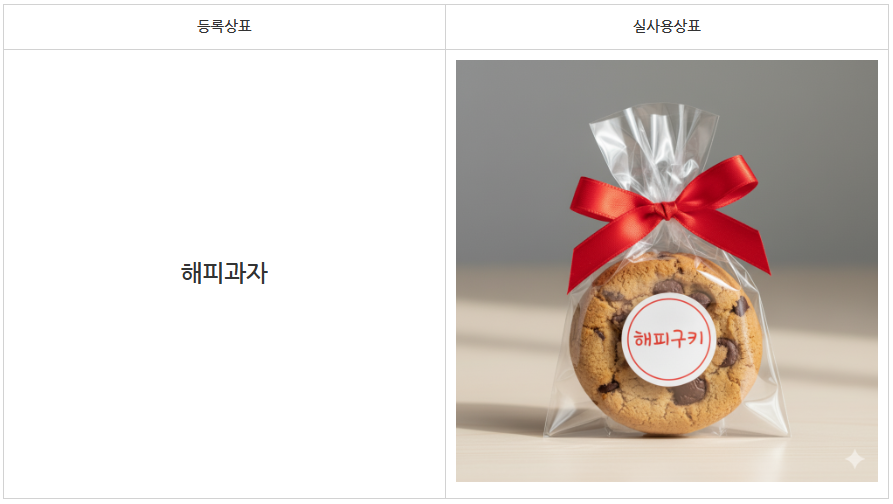
My Recent Success Story: My client registered “OO Snack” (OO과자) but had been using “OO Cookie” (OO쿠키) since 2019.
- Argument: “Snack” and “Cookie” are descriptive terms for the goods. The distinctive part “OO” remained identical.
- Result: Defense Successful. The trial was dismissed.
4. Dangerous Variations (Identity Denied)
However, changing the “Distinctive Part” (Dominant Part) is fatal.
- Removing the Logo:
- Registered: [Logo + Brand Name]
- Used: [Brand Name Only]
- Risk: If the logo was a key identifier, this might be considered non-use of the registered “combination” mark.
- Changing the Logo:
- Registered: [Old Logo + Name]
- Used: [New Logo + Name]
- Risk: High. The new logo creates a different visual impression.
- Separating Elements: Using only the logo when the text was also distinctive.

5. Strategic Advice: Don’t Gamble with Your Brand
While Korean courts are becoming more flexible (focusing on consumer perception rather than strict formalities), relying on this flexibility is risky.
Three Golden Rules for Brand Management:
- Use It As Registered: The safest route is always to use the mark exactly as it appears on your registration certificate.
- Re-File When Re-Branding: If you update your logo or change your brand font significantly, file a new trademark application immediately. Do not rely on the old registration to protect the new design.
- Periodic Audit: Check your portfolio. If your current usage has drifted away from your registration, you are vulnerable to a non-use cancellation attack by a competitor.
Sarang IP We provide expert legal counsel on Korean Trademark Law, including defense against Non-Use Cancellation Trials and portfolio management.
(Disclaimer: This post is for informational purposes only and does not constitute specific legal advice. Please consult with a professional attorney regarding your specific case.)