Almost every design team now has generative tools somewhere in its workflow: for moodboards, for variant exploration, for the first fifty shapes nobody will use. Until recently, no patent office had said what that means for a design application. Korea has now said it.
On 9 July 2026 the Ministry of Intellectual Property (MOIP), the Korean IP office, elevated to ministry status in October 2025 and long known abroad as KIPO, issued its Application Guide for Designs Created Using AI. It is guidance rather than legislation, but it tells applicants what examiners will look for, and the practical consequence is immediate: the evidence that decides your application has to be created while you are designing, not assembled after an office action arrives.
The question is not whether AI was used
Korean law requires that a design be created by a natural person; under Article 3 of the Design Protection Act, the right to obtain registration belongs to “the person who created the design” or their successor in title. An AI system cannot hold that position. So the guide does not ask whether a generative tool was involved: that is assumed. It asks whether the human contribution was substantial.
That word does the work. MOIP draws the line at whether the person’s input governed the dominant aesthetic impression of the resulting design.
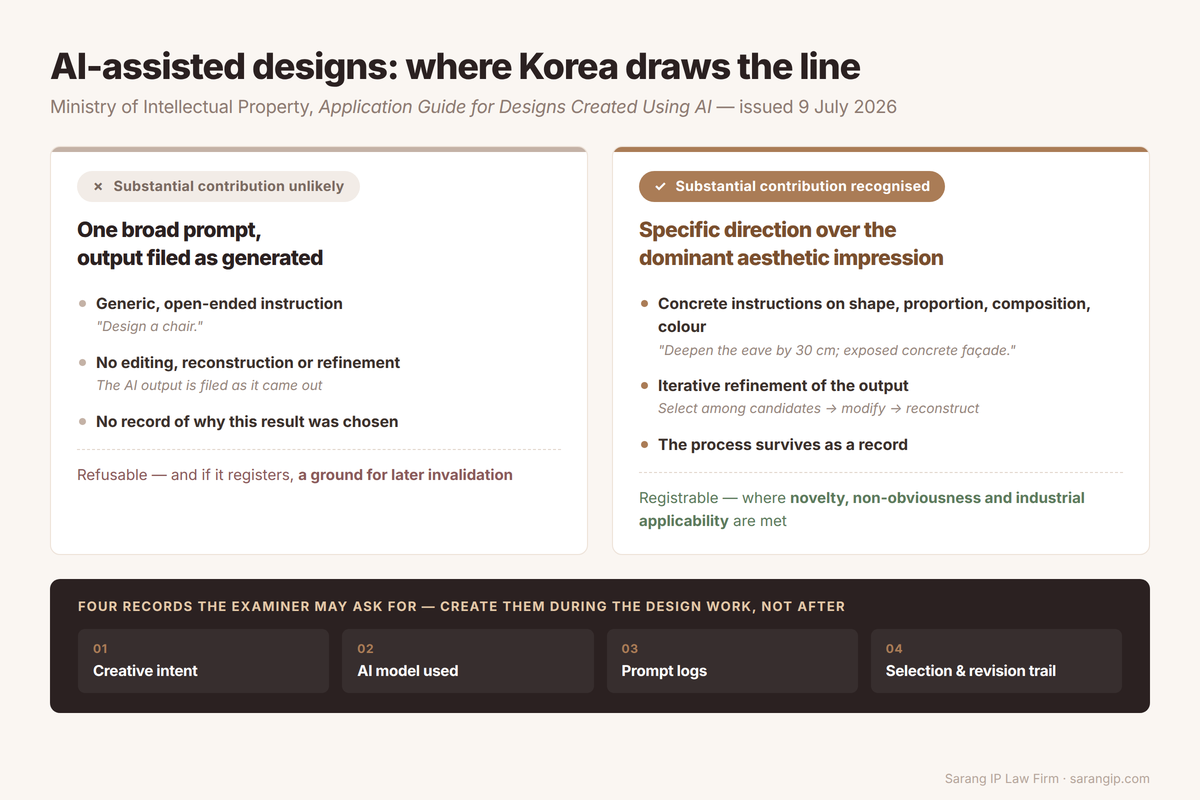
A single open-ended instruction (the guide’s own example is “design a chair”) followed by filing the output as it came out is unlikely to clear the bar. Concrete direction on shape, proportion, composition and colour, followed by selecting among candidates, modifying and reconstructing them, is what the guide treats as substantial.
Four records, and why they are hard to produce later
The guide identifies what an applicant should be able to show: the creative intent behind the design, the AI model used, the prompt logs, and the trail of selection, modification and reconstruction. It also expects a prior design search confirming the result is not simply a restatement of something already out there.
None of this is difficult while the work is happening. It becomes very difficult eighteen months later, which is the point at which an office action usually arrives. Prompt histories live in individual designers’ accounts, tools get switched, contractors move on. For cross-border filings the gap is wider still: the generative work is often done by a design team in one country while the Korean application is prosecuted by local counsel who never saw it. By the time the examiner asks how the design came about, the people who could answer are no longer on the project.
The practical instruction is therefore simple. Treat the AI-assisted design file the way you would treat an inventor’s notebook: one owner, one location, captured as you go.
Three traps that are not about AI at all
Inconsistent proportions across drawings. Generative output rendered from several angles frequently does not reconcile: the front view and the side view describe slightly different objects. In Korea that is not a drafting nuisance; it can defeat industrial applicability and sink the application on its own. Views must be reconciled before filing, not after.
Publishing the draft. Posting AI-generated concepts to a portfolio site or a social feed is a disclosure, and it can destroy novelty. Korea does provide relief: under Article 36 of the Design Protection Act a design disclosed by the creator can be excepted from novelty loss if the application is filed within 12 months, and the exception may be claimed at filing, during examination, or even at the registration stage. But it is relief, not a plan: it has to be claimed and evidenced, and it does not help against a third party who filed first.
Naming a creator who did not create. Listing a person as the designer where the human contribution was not in fact substantial is not a formality problem. If it emerges later, the registration is vulnerable to an invalidation trial, and by then the design is usually in the market and being enforced.
What to do before you file in Korea
- Decide now who owns the AI design record, and where it lives. One repository, not individual accounts.
- Capture prompts and iterations as the work happens, with dates.
- Keep the reasoning for the final selection in writing: one paragraph is enough, and it is the part nobody can reconstruct later.
- Reconcile all views against each other before drawings are finalised.
- Run a prior design search before publishing anything, and treat any public posting as starting a 12-month clock.
- Confirm internally that the named creator’s contribution was genuinely substantial under the standard above.
Korea has moved first here, and the direction is unlikely to be Korea-specific for long. Applicants who build the record now will simply have it when other offices ask.
References
Ministry of Intellectual Property, Application Guide for Designs Created Using AI, 9 July 2026 · press coverage
Design Protection Act of Korea, Articles 3 (entitlement), 33 (requirements for registration) and 36 (exception to loss of novelty)
Ministry of Intellectual Property (formerly KIPO): moip.go.kr
This content is for general informational purposes only and does not constitute legal advice. For specific matters, please contact Sarang IP Law Firm.