(Analysis of “Bomb Rice” and “VSP” Cases)
Every month, I hold an IP Practice Forum with Attorney Lee Dong-jun of Yuram Law Firm and our firm’s junior Patent Attorney Yoon Ji-young. Even after 18 years in this field, studying recent precedents is essential because IP law is always evolving.
In our recent session, we discussed a fundamental question: “What exactly does it mean to ‘use’ a trademark?”
You might think, “If I print a logo on a product, isn’t that trademark use?” Not necessarily. In Korean law, not every display of a logo counts as “Trademark Use.” This distinction is critical because if it’s not trademark use, it’s not trademark infringement.
Today, I will explain this concept using real court cases like the “Bomb Rice” and “VSP” rulings.
The Core Definition: “Source Identifier”
A trademark’s primary function is to distinguish your goods from others (Source Identification). Therefore, if a mark is displayed but does not function as a source identifier, it is NOT considered trademark use under the law.
Examples of “Non-Trademark Use” (No Infringement)
If your use falls into these categories, you may have a strong defense against infringement claims:
1. Descriptive Use Using a word to describe the product’s function, specifications, or compatibility.
- Example: Printing “For SONATA” on a car air cleaner package. This tells consumers the part fits a Hyundai Sonata, not that the part was made by Hyundai.
- Example: “Windows” on a software manual title. It describes the content, not the source of the manual itself.
2. Purely Decorative Use (Design) Using a logo or pattern solely for aesthetic appeal.
- Example: An animal shape on a necklace pendant or a pattern on a ring. If consumers see it as “pretty decoration” rather than “a brand logo,” it’s not trademark use.
- (Note: Some designs, like the Burberry Check, are exceptions because they are so famous they act as source identifiers.)
3. Promotional Goods (Freebies) Giving away branded items for free that are not traded independently.
- Case: A beer company giving away T-shirts with their beer logo “CASS”.
- Verdict: This is not trademark use for “clothing.” It is merely an advertising medium for “beer.”
Case Study 1: The “Bomb Rice” (Poktan-bap) Case
(Patent Court of Korea, Sept. 10, 2015, Case No. 2014Heo8861)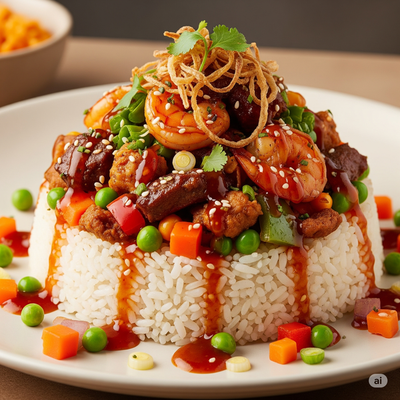
The Situation: A trademark owner registered “Bomb Rice” for the goods “Lunchbox (Bento).” A restaurant used “Bomb Rice” on its menu to describe a specific spicy rice dish.
The Issue: Did using the name on a menu count as using the trademark for “Lunchbox” goods?
The Verdict: NO. The court ruled that food served in a restaurant is not a “good” (which requires circulation and mass production). The menu usage was for a “Restaurant Service,” not for the “Lunchbox Product.”
- Result: The trademark registration for “Lunchbox” was cancelled for non-use because the owner only used it for a service, not the registered goods.
Case Study 2: The “VSP” Keyword Ad Case
(Patent Court of Korea, Sept. 15, 2010, Case No. 2010Heo3271)
The Situation: A competitor bought the keyword “VSP NTC” on a search engine’s “Sponsor Link” section to advertise their product. “VSP” was a registered trademark of another company.
The Issue: Is buying a keyword ad considered “Trademark Use” that infringes on the trademark owner’s rights?
The Verdict: NO. The court ruled that the term “VSP NTC” in the sponsor link served only to direct web traffic to the defendant’s website. The term did not appear on the defendant’s actual products or packaging. Furthermore, “VSP” was considered a generic abbreviation in the industry (Voltage Sag Protector), lacking distinctiveness.
- Result: No trademark infringement.
Why This Matters to Your Business
Understanding “Trademark Use” is crucial for three main reasons:
1. Defense Against Infringement If you receive a Cease & Desist letter, check if you are actually using the term as a trademark. If you are using it descriptively or decoratively, you might not be infringing.
2. Avoiding Cancellation (Non-Use) In Korea, if you don’t use your registered trademark for 3 years, it can be cancelled.
- Lesson: You must prove “Genuine Use.” Using a logo on a free giveaway (like the CASS T-shirt case) or on a menu (like the Bomb Rice case) might not save your “Goods” trademark from cancellation.
- (Remember the Big Mac case in Europe? McDonald’s lost the “Big Mac” trademark for chicken sandwiches because they couldn’t prove genuine use for that specific category.)
3. Digital Marketing & Hashtags Are social media handles or hashtags trademark use?
- Generic Hashtags:
#Deliciousor#SummerVibesare not trademark use. - Branded Hashtags: If a brand uses a unique hashtag (e.g.,
#MyBrandName) consistently to identify its products, it can be considered trademark use.
Conclusion
A trademark is more than just a word or a logo; it is a function. If it doesn’t tell the consumer “Who made this?”, it’s likely not a trademark in the eyes of the law.
Whether you are defending your business against a claim or trying to protect your own brand, understanding the nuances of “Trademark Use” is the first step in building a solid IP strategy.
Sarang IP We provide expert legal counsel on Korean Trademark Law, infringement defense, and non-use cancellation trials.
(Disclaimer: This post is for informational purposes only and does not constitute specific legal advice. Please consult with a professional attorney regarding your specific case.)