The Global Expansion Blockade
For CEO Hong, running a successful audio equipment brand in Korea was just the beginning. He was preparing for a major leap into the global market, with a specific focus on exporting to Türkiye (Turkey).
To succeed internationally, owning the .com version of your brand name is not optional—it is essential for credibility. However, when CEO Hong went to register the domain, he found it was already taken.
Upon investigation, the situation proved to be a personal betrayal. The .com domain had not been registered by a random stranger, but by a former employee who had recently resigned.

The Problem: Cybersquatting by an Insider
The former employee was squatting on the domain, effectively holding the brand hostage. CEO Hong only owned the local .kr domain, leaving his global expansion plans paralyzed.
The ex-employee had even registered the domain under their spouse’s name to hide their identity and complicate matters.
The Strategy: UDRP over Litigation
CEO Hong considered a civil lawsuit, but international domain disputes in court can take years. We needed a faster solution. Sarang IP recommended the UDRP (Uniform Domain-Name Dispute-Resolution Policy).
UDRP is an administrative proceeding used specifically for resolving disputes regarding generic top-level domains (like .com, .net, .org). It is faster, cheaper, and often more effective than traditional litigation for clear-cut cases of cybersquatting.
Building the Case
To win a UDRP case, we had to prove three specific elements:
- Identity: The domain name was identical or confusingly similar to CEO Hong’s registered trademark.
- No Rights: The former employee (and their spouse) had no legitimate right or business interest in the name.
- Bad Faith: The domain was registered and used in “bad faith.”
We argued that the timing of the registration (immediately post-resignation) and the use of a spouse’s name demonstrated a clear malicious intent to disrupt CEO Hong’s business and leverage the domain for unfair gain.

Former employee cybersquatting the company’s.com domain, hidden under a spouse’s name to obscure identity 
Building a UDRP case by proving an identical mark, no legitimate rights, and bad-faith registration
The Outcome: Surrender and Recovery
The pressure of the UDRP filing worked immediately.
Upon receiving the official dispute notification and realizing the strength of Sarang IP’s legal argument, the former employee contacted CEO Hong. Realizing they would lose the arbitration, they offered to voluntarily transfer the domain to end the conflict.
CEO Hong successfully secured the .com domain. Because the case was settled before the final panel decision, Sarang IP quickly withdrew the application, allowing us to refund a portion of the official filing fees back to the client.

UDRP filing pressures the cybersquatting former employee to surrender the disputed.com domain 
Stolen.com domain recovered and returned to the rightful trademark-owning company 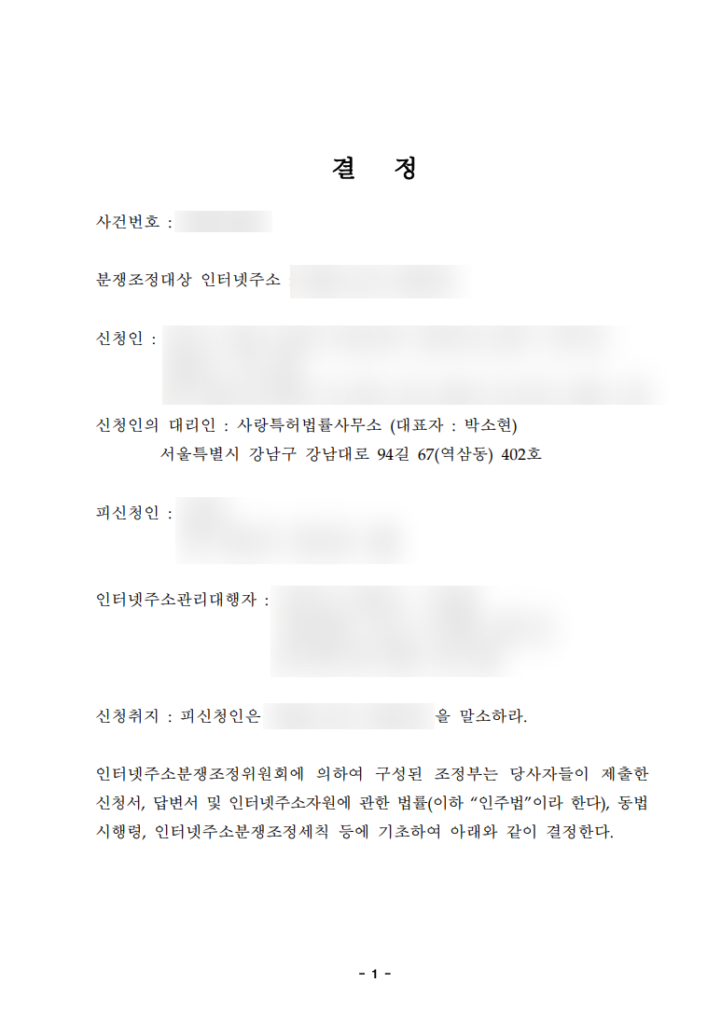
Brand owner regains control of its.com domain, clearing the path for global market expansion
Conclusion
A domain name is more than a web address; it is digital intellectual property.
While the best strategy is always to register key domains (especially .com) before you become famous, this case proves that all is not lost if a squatter strikes first. If you own the trademark, legal mechanisms like UDRP can help you reclaim what is rightfully yours.